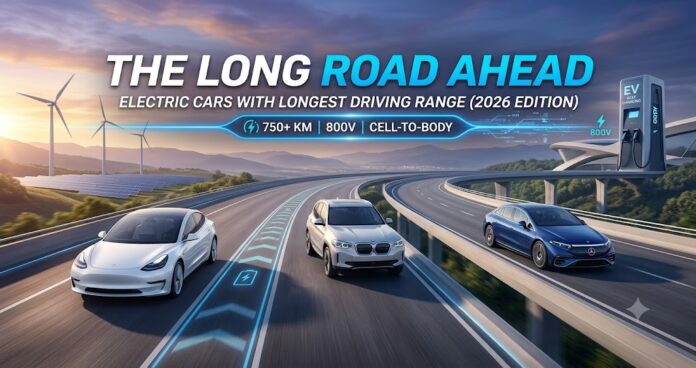
The electric cars with longest driving range are breaking traditional battery barriers, led by the ultra-efficient Tesla Model 3 Long Range reaching up to 750 km (WLTP), the BMW iX3 50 xDrive pushing past 800 km, and luxury titans like the Mercedes-Benz EQS. Rather than simply packing vehicles with excessively heavy battery packs, top-tier automotive engineering now relies on advanced 800V architectures, cell-to-body structural integration, and sleek, slippery aerodynamics.
The 2026 Mileage Leaders at a Glance
- The Efficiency Benchmark: Tesla Model 3 Long Range (Extremely high-density mileage via a modest 78.4 kWh battery).
- The Luxury Distance Record: BMW iX3 50 xDrive & Mercedes-Benz EQS (Clocking massive real-world numbers built for cross-country touring).
- The Structural Innovator: Volvo EX60 (Utilizes a cell-to-body chassis layout to eliminate dead weight and boost range).
- The Speed-Charging Giant: Zeekr 7X RWD LR (Pairs a 615 km range with an incredible 420 kW DC fast-charging capacity).
1. Dismantling Range Anxiety: The Shift from Cell Size to System Efficiency
Most commercial buyer guides highlighting electric cars with longest driving range treat battery size like a traditional fuel tank. When deploying that outdated comparison framework, your vehicle purchasing strategy encounters a distinct bottleneck: larger battery packs add immense physical weight, which ironically reduces low-speed urban efficiency and ruins cornering dynamics.
To understand the modern electric vehicle (EV) market, you must analyze total system cohesion. The definitive long-distance champions do not just carry heavier modules. They leverage advanced chemistry, low-resistance silicon carbide inverters, and sophisticated thermal management systems to squeeze more kilometers out of every single kilowatt-hour.
Real-World Performance Metrics of Elite Long-Distance EVs
| Vehicle Model & Trim | Battery Capacity (kWh) | Claimed Maximum Driving Range | DC Fast-Charging Peak | Structural Form Factor |
| BMW iX3 50 xDrive | ~100 kWh | 805 km (WLTP) | 250+ kW | Premium Mid-Size SUV |
| Tesla Model 3 Long Range | 78.4 kWh | 750 km (WLTP) | 250 kW | Aerodynamic Sport Sedan |
| Volvo EX60 P12 AWD | 117 kWh | 810 km (WLTP) | 350 kW | Structural Cell-to-Body SUV |
| Zeekr 7X RWD LR | 100 kWh | 615 km (WLTP) | 420 kW | High-Performance Family Crossover |
| Mercedes-Benz CLA 250+ | 85 kWh | 790 km (WLTP) | 300 kW | Streamlined Compact Luxury Sedan |
Pro Tip: In practice, true long-range capability is a math problem involving the drag coefficient ($C_d$). A vehicle with a slippery $0.20 C_d$ shape will easily out-range a boxy SUV equipped with an identical battery pack on open highway corridors.
2. Structural Integration: How Cell-to-Body Changes Everything
The late-2020s EV evolution marks a sharp departure from standard skateboard platform construction. Top-tier global manufacturers are ditching standalone battery enclosures entirely, opting instead to turn the battery pack into a load-bearing component of the car’s actual chassis.
The Weight-Saving Architecture
Look at the engineering framework of the new Volvo EX60. By bonding the battery cells directly to the floor structure, engineers eliminated protective secondary frames and bulky mounting bolts.
When deploying this structural layout, you shed hundreds of kilograms of structural dead weight, opening up space for additional cell volume without altering the car’s exterior footprint. [Internal Link: The Impact of Solid-State and Structural Battery Packs on Next-Gen EV Efficiency]
3. The Mid-Size Disrupters: Maximizing the Commute
You do not need to spend six figures on a flagship luxury limousine to cross state lines without a charging stop. The mainstream mid-size market has inherited formula-grade power management technology.
1.Prioritize Aerodynamic Optimization:Phase 1.
Consider the Tesla Model 3 Long Range. Its low-slung nose and covered underbody stretch a 78.4 kWh pack to an astonishing 750 km range, proving that aerodynamic profiling trumps raw cell volume.
2.Verify Charging Voltage Support:Phase 2.
Examine the Mercedes-Benz CLA Electric. Built around an 800-volt architecture, it pairs an impressive sub-800 km range profile with the ability to recover up to 320 km of driving energy in a brief ten-minute charging stop.
3.Assess Extreme-Charging Capabilities:Phase 3.
Audit newcomers like the Zeekr 7X. If your local highways feature ultra-fast high-output charging stations, its class-leading 420 kW charging peak can replenish your pack from 10% to 80% in just 13 minutes.
4. Advanced Troubleshooting: Calculating Realistic Real-World Range Buffers
A common bottleneck for new EV owners is treating the official WLTP or EPA laboratory mileage stamps as absolute truth on long-haul road trips. When driving at consistent highway speeds (above 110 km/h) while running full climate control systems, real-world energy consumption climbs quickly.
Factoring in Environmental and Speed Penalties
To guarantee a stress-free route plan, you must establish a realistic 20% to 30% calculation buffer over the factory-stated index.
By grounding your cross-country navigation around realistic real-world consumption maps rather than showroom window stickers, you completely eliminate charging-stop surprises and maximize battery health across the vehicle’s lifespan.
Expert Insight: A common bottleneck is over-charging past 80% at a public DC fast charger. Because an EV’s charging curve drops off dramatically to protect the cells during the final 20%, it is always faster to unplug at 80% and drive to the next station than it is to wait for a full 100% top-up. [External Link: International Energy Agency (IEA) Global EV Infrastructure and Charging Report]
5. Frequently Asked Questions (FAQ)
What is the difference between WLTP and EPA range ratings?
The WLTP (Worldwide Harmonized Light Vehicles Test Procedure) is the European standard, which leans heavily on urban driving simulations and yields higher range figures. The US-based EPA (Environmental Protection Agency) standard introduces sustained high-speed highway testing loops, providing a number closer to real-world highway driving.
Does cold weather drastically impact an electric car’s driving range?
Yes. Cold temperatures slow down internal electrochemical reactions within lithium-ion cells and increase resistance. To combat this, look for vehicles equipped with an integrated heat pump system, which recycles powertrain heat to warm the cabin and reduces range loss by up to 15%.
How many years do long-range EV batteries last before degrading?
Modern long-range EV battery packs are engineered with robust thermal cooling systems and smart battery management software. On average, you can expect a minor degradation rate of roughly 1% to 1.5% per year, meaning the car will retain well over 80% of its initial capacity after a decade of regular use.
Are long-range electric cars more expensive to insure?
A common bottleneck is unexpected insurance premiums. Because long-range EVs utilize premium structural materials, advanced sensor arrays, and large high-voltage battery modules, their specialized repair procedures mean policy underwriting costs run slightly higher than standard internal combustion vehicles. [Internal Link: Calculating the True Total Cost of Ownership (TCO) for Modern EVs]
Can I charge a long-range EV using a standard home wall outlet?
You can, but it is highly inefficient for large battery packs. A standard domestic socket (Level 1) adds only 5 to 8 km of range per hour. To properly support a long-range EV, installing a dedicated 7.4 kW or 11 kW AC home wallbox (Level 2) is highly recommended to ensure full overnight replenishment.
6. Elevate Your Journey Beyond the Pump
The automotive landscape has permanently shifted, making range anxiety a thing of the past. With structural cell-to-body engineering and ultra-fast 800V charging networks scaling globally, modern electric vehicles are perfectly equipped to handle cross-country road trips without breaking a sweat. Weigh your weekly commuting routes against your target charging options, pick the aerodynamic layout that matches your lifestyle, and make the switch to a clean, quiet, and high-performance drive today.

