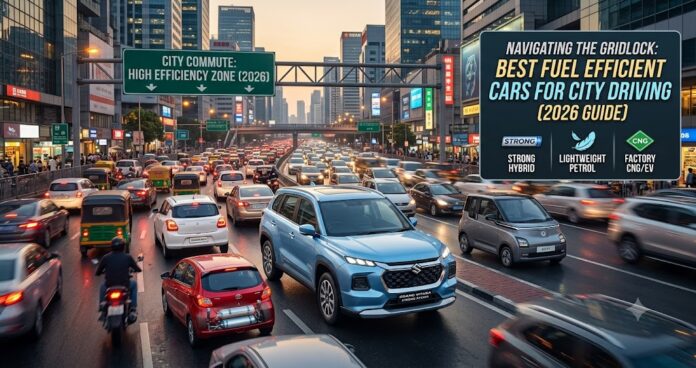
Urban stop-and-go gridlock destroys standard fuel economy, but selecting a vehicle optimized for low-speed efficiency solves this bottleneck. The best fuel-efficient cars for city driving rely on smart architecture—like immediate engine stop-start systems, strong hybrid powertrains, or dedicated urban EV layouts—to minimize consumption when idling. This comprehensive guide breaks down the top high-efficiency urban performers, raw data comparisons, and actionable strategy shifts to help you bypass soaring fuel costs during your daily commute.
The Ultimate City Mileage Key Takeaways
- Powertrain Matters: Strong hybrids perform at their absolute peak in heavy stop-and-go urban environments, using regenerative braking to continuously recharge their electric motors.
- The Weight Factor: Lightweight hatchbacks equipped with automatic manual transmissions (AMT) offer the lowest cost-to-mileage entry point for pure petrol commuters.
- Smart Features: Look for vehicles featuring “Idle Start-Stop” technology to prevent fuel drop-off while waiting at long traffic signals.
Why Urban Settings Require a Specialized Efficiency Strategy
When driving within tightly packed metropolitan sectors, traditional Internal Combustion Engine (ICE) vehicles operate at their lowest thermal efficiency. The constant cycle of accelerating from zero, braking, and idling at traffic signals consumes disproportionate amounts of energy relative to the distance covered.
To achieve high-density value in your daily commute, you must prioritize vehicle systems engineered precisely for low-speed operational dynamics.
The Real-World Impact of City Layouts on MPG and KMPL
In a highway setting, aerodynamic drag is the primary opponent. In the city, it is inertia. Launching a 1,500 kg vehicle from a dead stop over and over forces the engine to burn maximum fuel simply to break static friction. This is exactly where specific structural components like hybrid battery buffers, factory-fitted CNG systems, and ultra-lightweight chassis designs drastically change the ownership equation.
The Top Urban Efficiency Champions Reviewed
1. Strong Hybrids: The Absolute Traffic Kings
Vehicles operating on full or “strong” hybrid drivetrains perform fundamentally better in heavy gridlock than they do on open highways. At speeds under 40 km/h, cars like the Maruti Suzuki Grand Vitara (Strong Hybrid) or the Toyota Urban Cruiser Hyryder run almost exclusively on electric power derived from their onboard battery packs.
Expert Insight: When deploying a strong hybrid in dense urban corridors, your braking action acts as a generator. Regenerative braking captures kinetic energy normally wasted as heat through the brake pads and funnels it back into the battery, bringing your real-world urban efficiency close to an exceptional 24–25 kmpl.
2. Lightweight Petrol Hatchbacks: Agile Budget Commuters
For drivers who prefer standard petrol drivetrains without the cost premium of full hybridization, ultra-light hatchbacks like the Maruti Suzuki Celerio and Maruti Swift represent the peak of mechanical refinement. Armed with modern 1.0L to 1.2L three-cylinder setups, these platforms prioritize lower kerb weight over high-end horsepower.
Because they weigh significantly less than compact crossovers or standard sedans, they require far less initial torque to move through tight lanes. Squeezing into tight parallel parking spots becomes an easy afterthought, lowering daily driving friction.
3. Smart Alternatives: Bi-Fuel CNG and Dedicated City EVs
If your daily route regularly exceeds 40 to 50 kilometers, modern factory-fitted bi-fuel CNG options like the Tata Tiago CNG change the game. Tata’s twin-cylinder technology places two smaller, pressurized tanks cleanly beneath the boot floor. This structural shift completely preserves usable luggage space while delivering an incredibly cheap operational cost per kilometer.
Alternatively, dedicated short-wheelbase electric vehicles (EVs) remove tailpipe emissions and gasoline reliance entirely, making them the ultimate mechanical hack for predictable daily urban routes.
Data-Driven Head-to-Head: Urban Fuel Economy Profiles
To help clarify your purchasing decision, the table below maps out the official testing data against realistic urban projections across the three primary high-efficiency categories.
| Vehicle Model & Category | Powertrain / Fuel Type | ARAI Certified Efficiency | Expected Real-World Urban Range/Mileage | Prime City Benefit |
| Maruti Suzuki Celerio | 1.0L Petrol (AMT Hatch) | 26.68 kmpl | 18–22 kmpl | Ultra-lightweight frame, tight turning radius |
| Maruti Grand Vitara Hybrid | 1.5L Strong Hybrid SUV | 28.03 kmpl | 24–25 kmpl | Maximum EV-mode usage during heavy idling |
| Honda City e:HEV | 1.5L Strong Hybrid Sedan | 27.13 kmpl | 22–24 kmpl | Premium cabin comfort with zero urban penalty |
| Maruti Suzuki Wagon R | 1.0L Petrol / Bi-Fuel CNG | 37.5 km/kg (CNG) | 28–32 km/kg (CNG) | Tall-boy seating grants excellent forward visibility |
| Tata Tiago iCNG | 1.2L Bi-Fuel CNG | 26.49 km/kg (CNG) | 20–23 km/kg (CNG) | Twin-cylinder tank tech preserves all boot space |
Technical Features That Protect Your Wallet in Stop-and-Go Traffic
When comparing trim levels on a dealership floor, look for these specific engineering elements that directly protect your fuel pool from being drained by city driving:
- Integrated Starter Generators (ISG): Instead of keeping the combustion engine turning over while you wait at a 90-second traffic signal, an ISG shuts down fuel consumption completely. The second you release the brake pedal or touch the clutch, the system spins the engine back to life silently, eliminating starter motor drag.
- Electric Continuously Variable Transmissions (e-CVT): Found routinely in premium hybrid setups, e-CVTs completely avoid the step-gear shifts that cause traditional automatics to hunt for gears at lower urban speeds, keeping the motor continuously balanced at its peak efficiency index.
Driving Habits to Maximize City Fuel Economy
Choosing an efficient car is only half the battle. In practice, how you interact with the pedals inside heavy traffic corridors alters your overall fuel expenditure significantly.
Avoid the “Gap-Sprinting” Bottleneck
A common error made by daily commuters is racing aggressively into small openings in traffic, only to slam hard on the brakes twenty meters later. This pattern forces your engine to pump extra fuel through the injectors during sudden acceleration, only to dump that momentum immediately as friction heat through your brakes.
Instead, practice smooth anticipation. Leave a loose gap ahead of your bumper, allowing the car to glide steadily on its own rolling momentum. This smoothing technique keeps engine loads consistent and optimizes regenerative capture systems perfectly.
FAQ Section (Optimized for FAQ Schema)
Which fuel type is best for city driving if I want to minimize costs?
For drivers traveling fewer than 30 kilometers daily, a lightweight petrol hatchback with an automatic manual transmission (AMT) or a small EV offers the cleanest balance. If your daily city commute exceeds 50 kilometers, a factory-fitted CNG vehicle or a strong hybrid provides the fastest return on your initial investment via drastically lower running costs.
Do hybrid cars get better mileage in the city than on highways?
Yes. Strong hybrids are uniquely engineered to thrive in city environments. Because urban driving involves frequent braking and low-speed crawling, the vehicle runs primarily on its electric motor and continuously captures energy through regenerative braking. On highways, the petrol engine takes over completely at high speeds, reducing the hybrid’s overall efficiency advantage.
Does turning off the air conditioning save fuel in city traffic?
Operating your vehicle’s climate control system places a direct mechanical or electrical load on the engine architecture. In small-displacement petrol engines, turning off the air conditioning in slow traffic can improve your fuel economy by roughly 8% to 12%. However, modern automatic climate control systems reduce this drain once the cabin reaches its target temperature.
Why does real-world city mileage always fall short of advertised figures?
Advertised automobile figures are calculated within highly controlled laboratory settings on chassis dynamometers under idealized ambient conditions. Real-world urban driving introduces unpredictable variables like extended idling with full electrical loads, bad pavement, uneven tire pressure, and sudden acceleration, which combine to lower actual real-world numbers.
Are automatic cars less fuel-efficient in heavy city traffic?
Historically, older torque-converter automatic transmissions suffered from torque loss and lowered mileage in the city. However, modern Automated Manual Transmissions (AMT), dual-clutch setups, and advanced CVTs match or occasionally beat traditional manual gearboxes by executing shifts at mathematically ideal engine RPM boundaries.
Ready to Upgrade Your Urban Commute?
Beating the daily gridlock requires a car tailored explicitly to handle low-speed, high-inertia cycles. Weigh your daily mileage carefully against your initial purchase budget to pick the right platform.
For deep dives into real-world ownership data and emerging fuel-saving tech, take a look at our detailed exploration of [Internal Link: Understanding Hybrid Regenerative Braking Systems] or check out the latest safety parameters verified by [External Link: Society of Automotive Engineers (SAE) Efficiency Standards] to finalize your next vehicle purchase.

